Dump Trucking Regulations, Mapped to CFR Citations and Daily Tasks
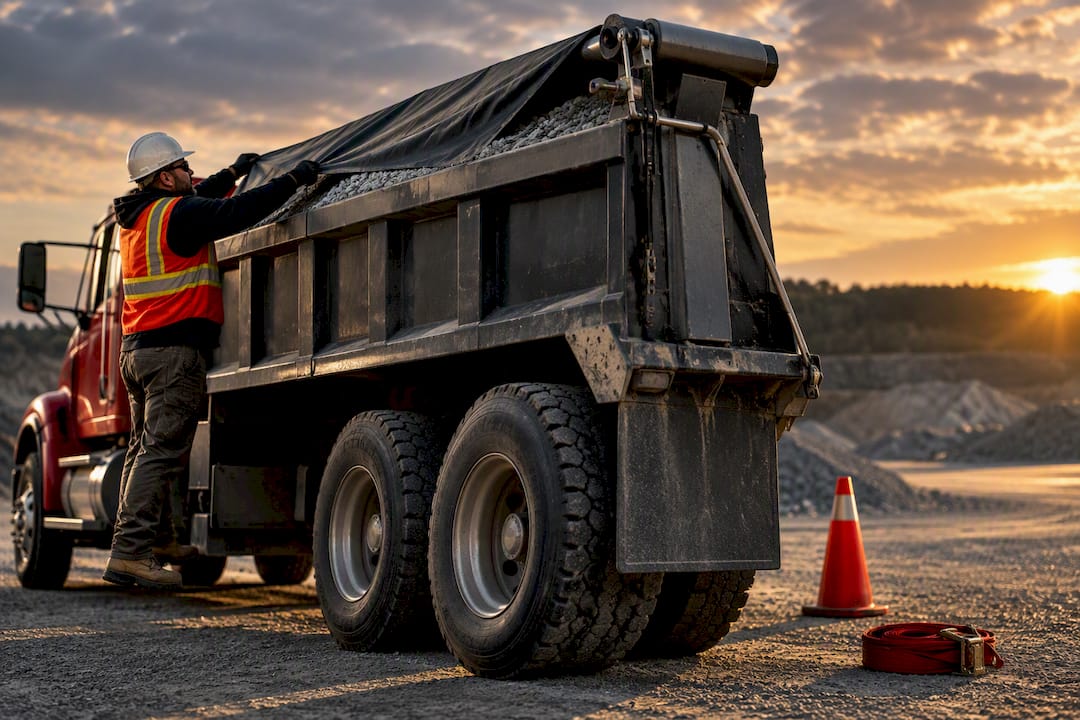
Operating a dump truck legally means clearing four hurdles at once: holding the right CDL class (Class B for a single unit at 26,001 pounds GVWR or more, Class A if a trailer’s GVWR tops 10,000 pounds), passing daily pre-trip and annual inspections, securing or tarping loose cargo under federal standards, and keeping your DOT registration, insurance, and hours-of-service records current. Miss any one of these, and a routine roadside stop turns into a fine or an out-of-service order.
TL;DR:
- Dump truck drivers must hold the appropriate CDL class based on weight and trailer configuration, with Class B required for trucks over 26,001 pounds GVWR and Class A if towing a trailer over 10,000 pounds GVWR.
- Daily pre-trip inspections and annual comprehensive inspections are legal obligations, with missing documentation being a common reason for violations during roadside stops.
- Cargo must be securely contained or covered, especially for loose aggregates like sand or gravel, with fines for uncovered loads starting around $250 in several states.
- Overweight and axle limit regulations vary by state, and permits are necessary for loads exceeding federal or state weight thresholds, especially in specialized earthwork or demolition hauling.
- Strict compliance with documentation, inspection reports, tarping, and environmental regulations is essential to avoid costly violations and out-of-service orders.
Table of Contents
- Federal Dump Truck Regulations That Set the Baseline
- Which CDL Class Does a Dump Truck Driver Need?
- Pre-Trip Checks and Annual Inspections: What the Law Actually Requires
- Cargo Securement and Tarping Rules for Loose Loads
- Weight Limits, Axle Rules, and When You Need a Permit
- Registration, DOT Numbers, and Insurance Minimums You Need on File
- Hours-of-Service, ELD Rules, and Drug Testing Basics
- What Violations Cost Money and Trigger Out-of-Service Orders
- How to Verify State-Specific Dump Truck Regulations Before You Drive
- How a Certified Contractor Organizes Dump Trucking Compliance
- Environmental Rules That Affect Dump Trucking Operations
- Safety Training and Certifications Dump Truck Operators Should Have
- What Should Dump Truck Operators Prioritize First?
- Get Compliant Hauling Without Managing It Yourself
- Primary Sources to Verify Dump Trucking Regulations
- Sources
- FAQ
Federal Dump Truck Regulations That Set the Baseline
The Federal Motor Carrier Safety Administration writes the rules that every state builds on. FMCSA’s authority runs through 49 CFR, and several parts touch dump truck operations directly: CDL standards, vehicle inspection and maintenance, cargo securement, and hours-of-service limits. States can add stricter requirements, but they cannot go below the federal floor.
For dump truck compliance specifically, four parts of 49 CFR matter most:
- Part 383 governs CDL classifications and testing standards.
- Part 392 covers driving rules, including the pre-trip inspection duty.
- Part 393 sets cargo securement requirements, including load coverage.
- Part 396 governs vehicle inspection, repair, and maintenance, including the annual inspection.
In practice, this means a driver in Kansas and a driver in Iowa follow the same federal minimums, even if their home states layer on extra permit or tarping rules. Knowing which CFR section governs a specific obligation lets you settle disputes with an inspector by pointing to the actual regulation rather than arguing from memory.
Which CDL Class Does a Dump Truck Driver Need?
The license threshold comes down to weight and configuration, not truck size alone. A single-unit dump truck with a gross vehicle weight rating of 26,001 pounds or more requires a Class B CDL. Add a trailer, like a pup trailer for extra aggregate capacity, and the math changes: if that trailer’s own GVWR exceeds 10,000 pounds, the driver needs a Class A CDL instead.
That trailer detail trips up a lot of fleet managers. A driver qualified for years on a straight dump truck can suddenly be under licensed the day dispatch hooks up a pup trailer for a bigger job.
Beyond the license class itself, drivers need:
- A current medical examiner’s certificate on file, since dump truck driving almost always falls under DOT physical requirements.
- A complete driver qualification (DQ) file, kept by the motor carrier, covering the license, medical card, road test, and employment history.
- Compliance with minimum age rules. Interstate hauling generally requires drivers to be 21 or older, even though some states allow younger drivers intrastate.
- Proper self-certification of driving type (interstate, intrastate, or excepted) filed with the state licensing agency.
Pre-Trip Checks and Annual Inspections: What the Law Actually Requires
Inspection duties split into two tiers, and confusing them is one of the most common paperwork mistakes in the industry.
- Daily pre-trip inspection. 49 CFR 392.7 requires drivers to inspect brakes, lights, tires, coupling devices, and cargo securement before every trip. Skipping this isn’t just risky; it’s a documented violation the moment an inspector asks for the driver’s vehicle inspection report.
- Annual (periodic) inspection. 49 CFR 396.17 requires a comprehensive inspection at least once every 12 months, covering brakes, steering, suspension, frame, and more. Proof of that inspection has to live both in the carrier’s files and inside the vehicle.
- Daily Driver Vehicle Inspection Report (DVIR). Under 396.11 and 396.13, drivers must document defects found during or after a trip, and carriers must fix anything that affects safety before the truck runs again.
Pro Tip: Keep a physical copy of the current annual inspection sticker and report in the cab, not just a scanned file back at the office. Inspectors ask for it on the spot, and “it’s in our system” doesn’t satisfy the request during a roadside stop.
The most common failure isn’t a broken part. It’s a missing sticker or an unsigned DVIR that makes a compliant truck look noncompliant on paper.
Cargo Securement and Tarping Rules for Loose Loads
49 CFR 393.100 sets the federal baseline: cargo must be contained, immobilized, or secured so it cannot leak, spill, blow, or fall from the vehicle. For a dump truck hauling sand, gravel, demolition debris, or asphalt millings, that standard usually means a tarp or an equivalent cover, since loose aggregate is nearly impossible to “secure” any other way.
FMCSA’s cargo securement standards also set performance criteria rather than mandating specific products, so an existing tarping system that meets the load-retention standard doesn’t need to be replaced just to match a newer design.
- Federal rule: prevent leaking, spilling, blowing, or falling cargo.
- Practical result: loose aggregates and demolition debris typically require full tarp coverage.
- State variance: tarping statutes differ on when coverage is mandatory (some exempt short hauls or certain material types).
By the numbers: Fines for running an uncovered load often start around $250 per violation in states that enforce tarping statutes, and repeat violations climb from there.
Before running a new route, check that state’s specific tarping statute. What counts as “loose material” under one state’s code doesn’t always match the next state over.
Weight Limits, Axle Rules, and When You Need a Permit
Federal law caps gross vehicle weight at 80,000 pounds on the Interstate System, but that number only tells part of the story. The actual limit for any given truck depends on axle spacing under the federal bridge formula, which spreads weight across more axles to protect pavement and bridges from concentrated loads.
- Single axle weight is generally capped at 20,000 pounds federally, with tandem axles capped at 34,000 pounds.
- The bridge formula can reduce allowable gross weight below 80,000 pounds if axles are spaced too closely together.
- Some states set their own axle maximums and grant exemptions for vehicles built for specialized work, so a rule that applies in Missouri may not apply identically in Nebraska.
- Overweight or oversize permits become necessary any time a load exceeds standard federal or state limits, which happens often in demolition and earthwork hauling where material density varies load to load.
Permit triggers usually show up before the trip, not after. If a load calculation puts you within a few thousand pounds of the limit, get the permit rather than gamble on a scale check.
Registration, DOT Numbers, and Insurance Minimums You Need on File
A USDOT number is required for most carriers operating in interstate commerce, and many states require one for intrastate hauling too once a truck crosses certain weight thresholds. Registration runs through the MCS-150 filing, which needs updating biennially or whenever fleet details change.
- DOT numbers are commonly assumed to apply only to interstate work, but state-level thresholds frequently pull intrastate haulers into the same registration requirement.
- Operating authority (an MC number) generally applies to for-hire carriers, while private carriers hauling their own materials may not need it.
- Public liability insurance minimums scale with cargo risk: $750,000 for nonhazardous property in interstate commerce, rising to $1,000,000 or more for oil and hazardous material categories, and up to $5,000,000 for the highest-risk cargo classes.
Confirm current minimums directly with FMCSA before binding a policy, since coverage requirements are tied to cargo classification, not truck type alone.
Hours-of-Service, ELD Rules, and Drug Testing Basics
Property-carrying drivers, dump truck operators included, run under the standard HOS limits: 11 hours of driving after 10 consecutive hours off duty, a 14-hour on-duty window that can’t be extended by breaks, a required 30-minute break after 8 cumulative hours of driving, and weekly caps of 60 or 70 hours depending on the carrier’s operating schedule.
- Electronic logging devices are mandatory for most drivers required to keep records of duty status, with narrow exemptions for short-haul drivers who stay within a defined air-mile radius and return to the same location each shift.
- Drug and alcohol testing programs require pre-employment testing, random testing at set annual rates, and mandatory post-accident testing.
- Employers must query the FMCSA Drug and Alcohol Clearinghouse annually for every driver and before hiring.
Short-haul aggregate routes sometimes qualify for the ELD short-haul exception, but that exception has strict mileage and duty-hour boundaries. Confirm eligibility before assuming a truck is exempt.
What Violations Cost Money and Trigger Out-of-Service Orders
Roadside inspections consistently flag the same two problem areas: missing or incomplete documentation, and unsecured or uncovered loads. Both are avoidable, and both are common enough that inspectors check for them first.
- Uncovered loads often draw fines starting around $250, with repeat citations pushing higher.
- Missing annual inspection proof or an incomplete DVIR routinely leads to written violations even when the truck itself is mechanically sound.
- Egregious hours-of-service violations, such as driving well past the 11-hour limit, and critical vehicle defects like brake failures, typically result in higher civil penalties and an immediate out-of-service order.
- Clearing an OOS order requires fixing the specific defect or violation on-site or arranging a tow, then documenting the correction before the vehicle returns to service.
The fastest way to avoid an OOS order is to treat documentation as seriously as mechanical maintenance. A truck in perfect working order can still get parked over a missing sticker.
How to Verify State-Specific Dump Truck Regulations Before You Drive
Federal rules are the floor, not the ceiling. Every state adds its own layer on tarping, permits, and axle limits, and assuming one state’s rule applies everywhere is how fines happen.
- Check the destination state’s DOT website for tarping statutes and definitions of “loose material,” since these vary more than most operators expect.
- Confirm GVWR-based registration thresholds, since intrastate exemptions aren’t universal.
- Contact the state permit office if any load approaches standard weight or size limits.
- Note seasonal restrictions, like spring weight limits some states impose to protect roads during thaw.
- Keep a one-page “state rules” reference per route so drivers aren’t guessing at the scale house.
How a Certified Contractor Organizes Dump Trucking Compliance
Cornelius Wrecking holds OSHA and asbestos abatement certifications, which shapes how compliance gets built into everyday hauling work rather than treated as a separate task. That structure typically includes scheduled preventive maintenance instead of reactive repairs, in-cab DVIR filing so documentation exists the moment an inspection happens, complete driver qualification files, and routine tarping checks before loads leave the site.
For projects involving regulated debris, hazardous material residue, or multi-jurisdiction hauling, that level of organization matters more than it does for a single local load. Hiring a contractor with certified abatement experience reduces the compliance burden on a project team that isn’t equipped to track CFR-level detail on every haul.
Environmental Rules That Affect Dump Trucking Operations
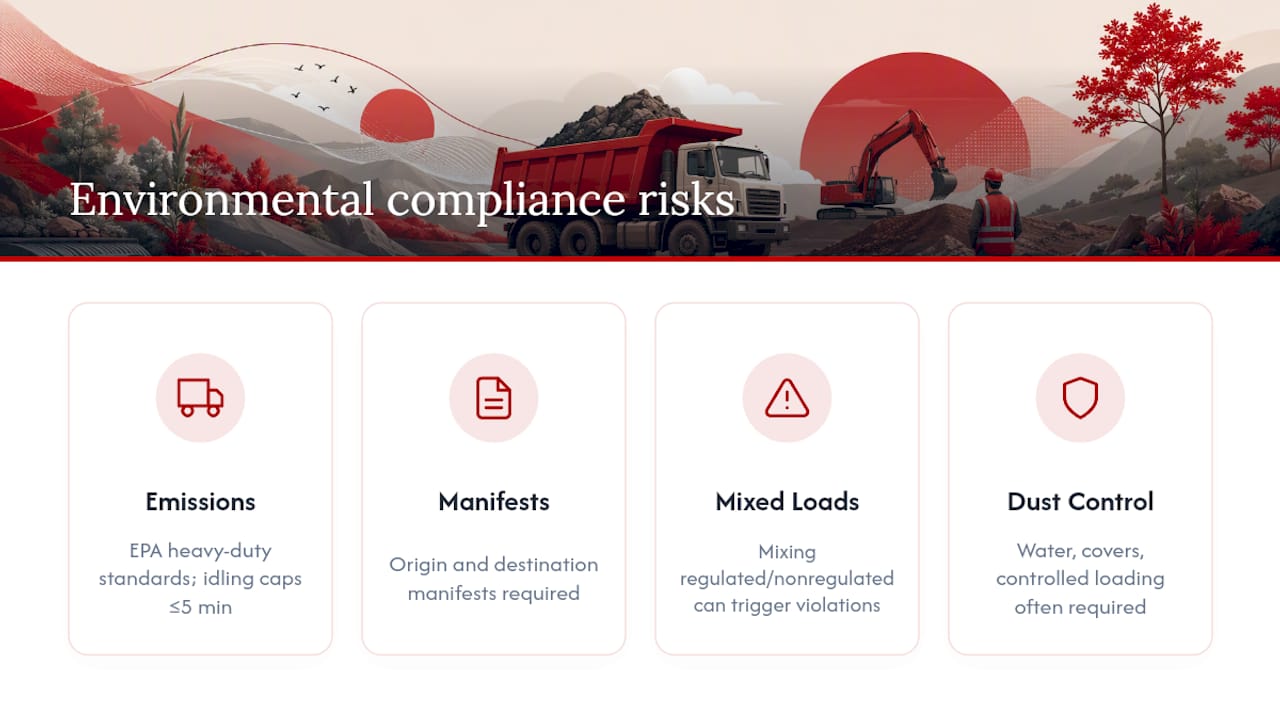
Emissions and waste disposal rules add a second compliance layer on top of safety regulations, and they matter more for dump trucking than most drivers realize. Diesel dump trucks fall under EPA emissions standards for heavy-duty vehicles, which govern everything from engine certification to idling restrictions in many municipalities. Some cities and counties cap idling time at five minutes or less, with fines issued separately from any DOT violation.
Waste disposal adds another dimension entirely. Hauling demolition debris, contaminated soil, or construction waste often means the material itself is regulated, not just the vehicle carrying it. Landfills and transfer stations typically require manifests documenting what’s being hauled, where it originated, and where it’s headed, especially for anything that could contain asbestos, lead paint residue, or other hazardous components.
Operators moving debris from older buildings or industrial sites need to confirm whether the material requires special handling before it ever reaches the truck bed. Mixing regulated and nonregulated waste in the same load can turn an entire haul into a hazardous materials violation, even if the truck itself was never carrying anything explicitly labeled hazardous.
State environmental agencies also regulate dust control during loading and transport, since airborne particulate from dry aggregate or demolition debris falls under air quality rules in many jurisdictions. Water trucks, covered loads, and controlled loading procedures aren’t just good practice. They’re often a permit condition tied directly to the environmental clearance for the project generating the material.
Safety Training and Certifications Dump Truck Operators Should Have
Beyond the CDL itself, several training programs separate a genuinely prepared operator from one who’s simply licensed. OSHA 10-hour and 30-hour construction safety courses cover site hazards that a standard CDL test never touches, from trench safety near excavation sites to overhead hazard awareness on demolition projects.
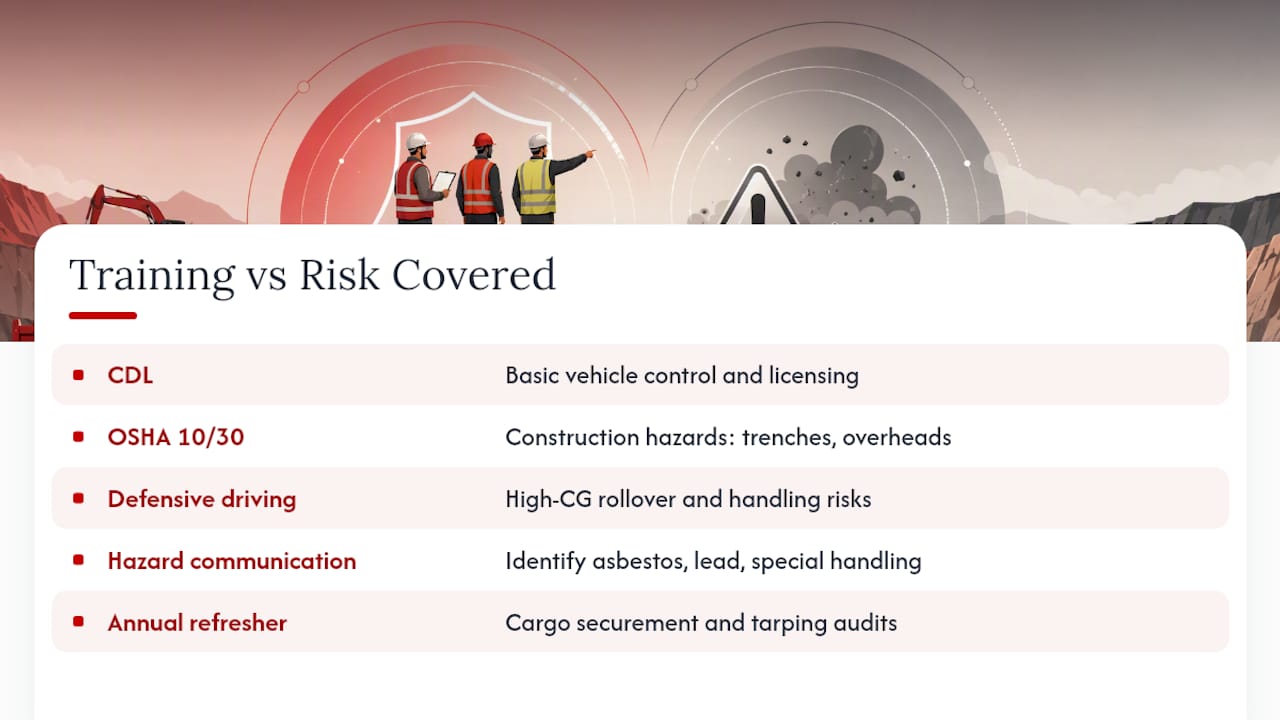
Defensive driving certification, often through the National Safety Council or a similar recognized program, addresses the specific risks of operating a high-center-of-gravity vehicle that’s frequently loaded near its weight limit. Dump trucks roll over more easily than flatbeds carrying the same tonnage, and that risk profile deserves dedicated training rather than assuming standard CDL instruction covers it.
For operators hauling debris from demolition or industrial sites, hazard communication training becomes essential, particularly around recognizing materials that may require special handling, like asbestos-containing debris or lead-based materials from older structures. A driver who can identify a red flag before loading avoids the compliance mess of hauling something that needed a manifest it never got.
Employers should also budget for refresher training on cargo securement and tarping procedures at least annually, since new hires learn the basics but experienced drivers sometimes drift from proper technique over time. A short annual audit of actual tarping practice, not just a signature on a training form, catches the gap between what a driver was taught and what they’re actually doing on-site.
What Should Dump Truck Operators Prioritize First?
Documentation beats good intentions every time an inspector shows up. Make daily inspections and DVIR filing a habit, not an afterthought, and keep both a paper and digital backup in the cab. Train drivers on tarping and securement, then actually audit those records monthly instead of assuming compliance holds steady on its own. When a load involves hazardous residue or crosses multiple state lines, that’s the point to bring in a certified contractor rather than stretch an in-house crew past its expertise.
— Zach
Get Compliant Hauling Without Managing It Yourself
Cornelius Wrecking handles dump trucking and hauling as part of a broader demolition and excavating operation, backed by OSHA and asbestos abatement certifications that most independent haulers simply don’t carry. That matters most on projects generating debris that needs special handling: demolition waste, contaminated soil, or materials tied to older industrial and commercial structures.

Instead of coordinating a separate hauling contractor, a demolition crew, and a permitting process across state lines, a single certified contractor manages the load from breakdown to disposal. That reduces the number of parties responsible for compliance on a single project, which matters when regulated material, multi-jurisdiction permits, or hazardous residue are part of the job. Reach out through Corneliuswrecking for a project estimate, or review the full service list to see how hauling fits alongside demolition, excavation, and site clearing work.
Primary Sources to Verify Dump Trucking Regulations
- FMCSA Part 396 Inspection and Maintenance Rules for annual inspection and DVIR requirements.
- 49 CFR 393.100 Cargo Securement Standards for load coverage and tarping obligations.
- FMCSA Pocket Guide for consolidated CDL, HOS, and registration references.
State DOT websites carry the operative local rules on tarping, permits, and axle limits that federal sources don’t cover in detail. Bookmark both the FMCSA regulation search and your state’s trucking permit office before planning a multi-state route.
This article is general information, not a substitute for advice from a qualified lawyer. Consult a qualified legal professional about your own circumstances before acting on anything here.
Sources
- Inspection, repair, and maintenance (Part 396) | FMCSA
- 49 CFR 393.100 — Applicability and general requirements of cargo securement standards
- FMCSA pocket guide (April 2024)
FAQ
What Requirements Do You Need to Drive a Dump Truck?
You need a Class B CDL for a single-unit dump truck at 26,001 pounds GVWR or more, or a Class A CDL if a trailer’s GVWR exceeds 10,000 pounds. You also need a current medical examiner’s certificate, a complete driver qualification file, and compliance with hours-of-service and drug testing rules.
What Is the New CDL Rule Affecting Truckers?
Federal enforcement has tightened around English language proficiency requirements for commercial drivers, along with stricter verification of medical certification and license status through the CDL information system. These changes affect eligibility checks rather than the underlying CDL class thresholds, which remain unchanged.
What Size Dump Truck Does Not Require a CDL?
A dump truck with a gross vehicle weight rating under 26,001 pounds and no trailer exceeding 10,000 pounds GVWR generally doesn’t require a CDL under federal standards. Many smaller dump trucks used for landscaping or light hauling fall under this threshold, though some states set additional licensing requirements below the federal CDL line.
What Is the 30 Minute Break Rule in Trucking?
Property-carrying drivers must take a 30-minute break after accumulating 8 cumulative hours of driving time. This break can be satisfied with off-duty time, sleeper berth time, or on-duty non-driving time, but driving cannot resume until the break requirement is met.
Does Cornelius Wrecking Handle Regulated Dump Trucking Loads?
Cornelius Wrecking offers dump trucking and hauling services backed by OSHA and asbestos abatement certifications, making it suited for hauling debris that requires special handling. Pricing depends on project scope and is available by contacting the company directly through its services page.
Planning a demolition or excavating project?
Get a fast, no-obligation quote from Cornelius Wrecking.
Request a Quote