50 ppm Compliance Prevents Delays: PCB Removal for EHS Managers
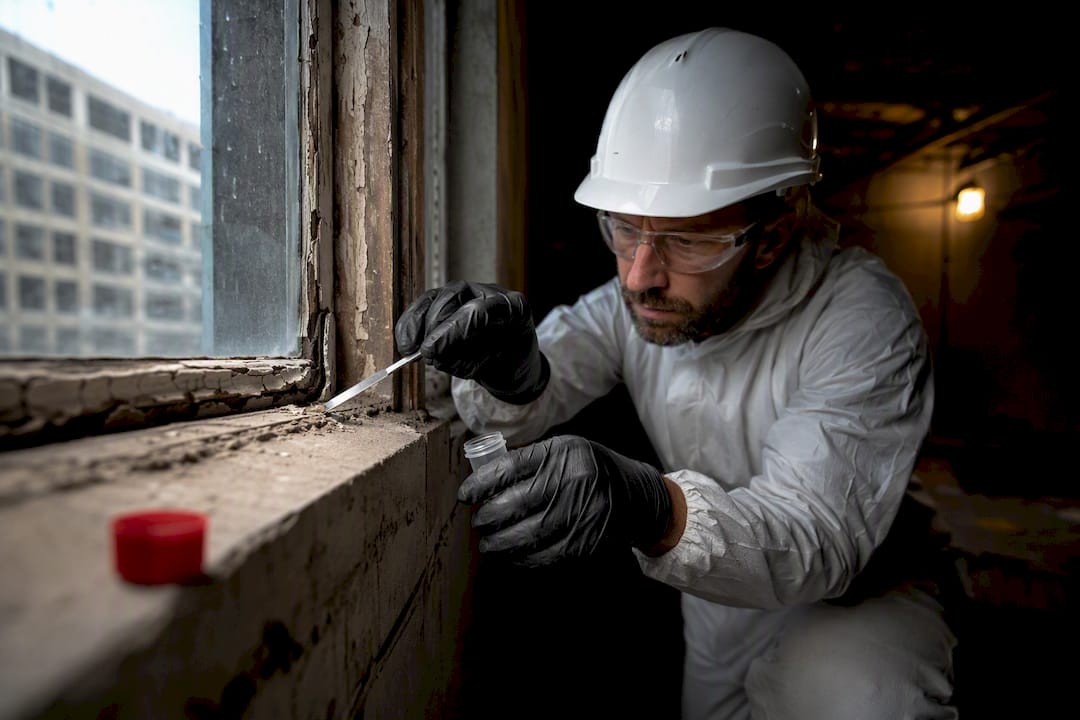
The right first move is never a swinging wrecking ball. It’s identifying and safely removing or containing PCB-containing materials in a controlled abatement phase before any structural demolition starts. That decision hinges on one number: the 50 ppm TSCA breakpoint that determines how a material must be handled and disposed of. Lock in your abatement plan and disposal route under EPA and OSHA guidance before a single wall comes down, because generator liability follows you long after the debris is hauled away.
TL;DR:
- Proper sampling and classification of PCB materials must be completed before removal begins to prevent costly project delays and disposal issues.
- Removal should be sequential and involve containment methods like wet cutting and immediate bagging to reduce airborne contamination and cross-site spread.
- Disposal paths depend on the PCB concentration, with materials over 50 ppm following stricter TSCA regulations and requiring confirmed acceptance before removal.
- Worker exposure controls, including PPE, air monitoring, and hygiene protocols, are essential to minimize inhalation and dermal contact risks during abatement.
- Documenting disposal compliance and project closeout sampling are critical to protect against ongoing liabilities and verify successful remediation.
Table of Contents
- What Does PCB Removal in Demolition Actually Require?
- How Do You Remove and Contain PCB Materials Safely?
- Where Does PCB Waste Go After Removal?
- What Exposure Controls Protect Workers During PCB Abatement?
- What Site Controls Keep PCBs From Spreading Off-Site?
- What Documentation Protects You From Generator Liability?
- How Do You Verify and Close Out a PCB Abatement Project?
- Field Perspective: Lessons From Cornelius Wrecking’s PCB-Aware Projects
- Why the Conventional Advice on PCB Removal Falls Short
- Qualified Demolition Partners Reduce Your PCB Compliance Risk
- Primary Regulatory and Technical Resources
- Sources
What Does PCB Removal in Demolition Actually Require?
Before anyone picks up a pry bar, you need a documented picture of what’s in the building and how much PCB it’s carrying. That means a formal building characterization and sampling plan, targeted at the materials most likely to hold polychlorinated biphenyls: window caulk, door and expansion joint sealants, mastics under flooring, glazing compounds, and light ballasts manufactured before 1979. These weren’t obscure additions. Manufacturers used PCB-laden plasticizers in caulk and sealant formulations for decades, which is why many older commercial and industrial buildings carry legacy contamination in places nobody thinks to check until a lab report comes back.
Sampling has to follow a defensible protocol, not a guess. Collect bulk samples of suspect materials, maintain strict chain-of-custody documentation from field to lab, and use accredited analytical methods rather than assuming a material is “probably fine” because it looks like standard caulk. Presumptive assumptions without data are a liability, not a shortcut. Once results come back, you classify the waste stream. Material with PCB concentrations of 50 ppm or higher generally falls under EPA’s TSCA disposal rules, and the classification you land on, bulk product waste or remediation waste, determines your entire downstream disposal pathway.
That classification decision carries weight most project teams underestimate.
The Cost of Guessing: Skipping proper classification and locking in a disposal destination before removal begins is one of the most common causes of project delays and cost overruns, because facilities that discover unclassified or misrouted PCB waste at the gate will reject the load outright.
Your written abatement plan needs to nail down four things before mobilization:
- A removal schedule sequenced ahead of structural demolition, not layered on top of it
- A confirmed disposal destination with documented acceptance
- Notification requirements satisfied under the applicable CFR provisions
- Contingency procedures for unexpected finds, like a ballast or transformer nobody flagged in the survey
Skipping any one of these turns a routine abatement job into a regulatory scramble.
How Do You Remove and Contain PCB Materials Safely?
Selective removal beats brute force every time. The sequence matters: pull intact PCB-containing materials off the substrate before any demolition activity disturbs the surrounding structure. This isn’t just a safety preference, it’s often the most cost-effective route, since leaving contaminated caulk or mastic in place until it’s mechanically pulverized turns clean structural material into contaminated debris that now has to be managed at remediation scale.
Here’s the practical workflow crews use on a well-run abatement job:
- Survey and flag every location identified in the sampling plan before any tools touch the material.
- Wet the material before cutting or scraping to suppress dust and limit airborne fiber and particulate release.
- Remove by hand tools wherever feasible, reserving power tools for material that won’t release with manual methods.
- Bag or wrap immediately at the point of removal rather than staging loose material in open containers.
- Transfer to secure staging in labeled, sealed containers pending manifest and shipment.
Containment on the working floor should include tented or barricaded work zones, negative-pressure setups where dust generation is significant, and clearly marked drop zones so removed material never sits on open ground waiting to be tracked around the site. Local exhaust ventilation paired with HEPA-filtered vacuum systems handles the fine particulate that wet methods alone won’t catch. Mechanical assistance, like a mini excavator with a shear attachment, has a role once materials are cleared and you’re moving into bulk structural demolition, but it has no business near a wall section that still carries unremoved PCB caulk.
Pro Tip: Keep a dedicated “clean” and “dirty” tool set for abatement crews. Cross-using demolition equipment between PCB removal zones and clean debris handling is one of the fastest ways to spread contamination to material that would otherwise ship as ordinary construction debris.
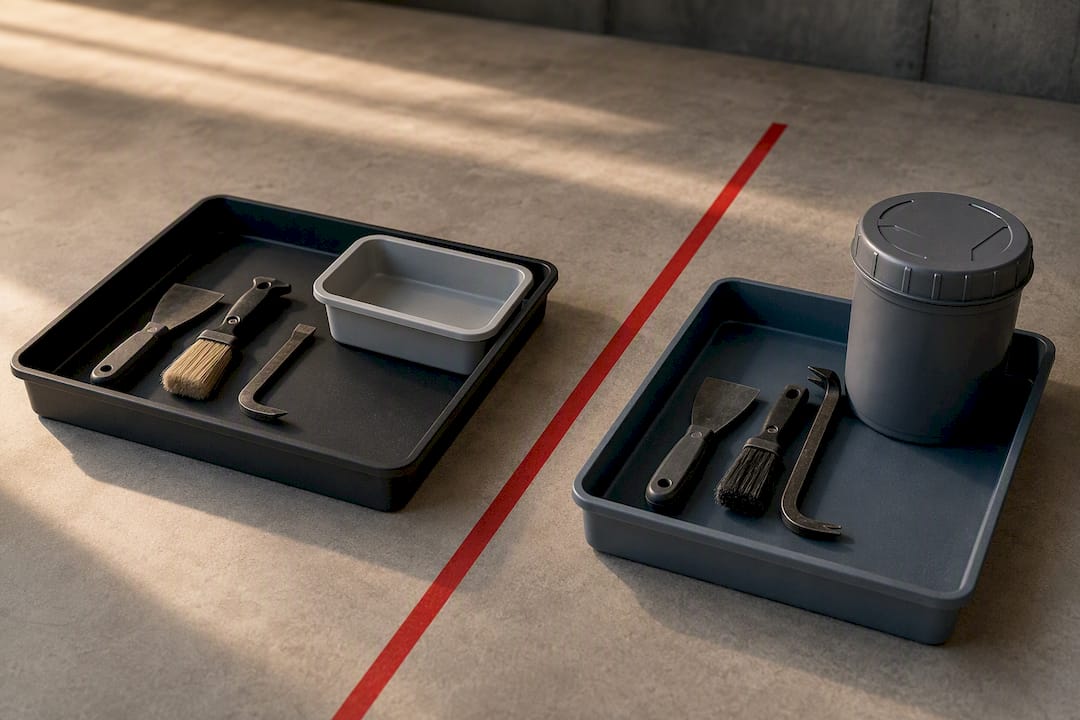
Daily housekeeping isn’t optional busywork here. Wipe down surfaces, collect wetting water rather than letting it run off, and close out each work area before crews move to the next zone.
Where Does PCB Waste Go After Removal?
Disposal planning has to happen before removal starts, not after you’re holding a truckload of bagged material with nowhere confirmed to send it. The classification you established during sampling drives everything downstream. Bulk product waste, PCB-containing caulk or sealant still attached to a substrate at concentrations at or above 50 ppm, follows a different disposal path than remediation waste, which covers contaminated soil, building materials, and debris generated during cleanup itself.
Under 40 CFR 761.62, certain PCB bulk product wastes can go to a municipal landfill if that facility meets specific acceptance criteria, which is a narrower and often cheaper option than a dedicated TSCA facility. Remediation waste, governed by 40 CFR 761.61, typically requires notification and either a self-implementing disposal procedure or a performance/risk-based approval, depending on concentration and site conditions. Regional flexibility exists too. Washington State’s environmental agency, for example, expanded disposal options for nonliquid remediation waste using alternate extraction methods, which means your options may be broader than a national guidance document alone suggests, but you have to confirm what your specific region and receiving facility currently accept.
Before the first truck leaves the site, get these locked down:
- Written pre-notification and confirmed acceptance from the receiving disposal facility
- Waste profile documentation matching your lab classification
- Signed manifests ready for the specific waste stream and destination
- Transport logistics that account for containment integrity in transit, not just loading
When material needs stabilizing or packaging before shipment, suppliers offering engineered packaging materials can help secure loose or friable waste for transport without adding a separate handling step on-site.
What Exposure Controls Protect Workers During PCB Abatement?
Cutting and sanding PCB-containing sealants generates the highest-risk tasks on an abatement job, and the exposure pathways that matter most are inhalation of dust and vapor and dermal contact from handling contaminated material directly. OSHA’s PPE program guidance applies directly here: proper respirator selection, documented fit-testing, and routine equipment maintenance aren’t paperwork exercises, they’re what stands between a worker and a measurable body burden.
A congener-level exposure study found that hygiene measures, handwashing in particular, reduced PCB contamination on workers’ hands by roughly 75% during demolition and remediation tasks. That’s a bigger risk reduction than most crews expect from something this simple.
Build your exposure program around these elements:
- Task-based air monitoring during sealant cutting, sanding, and any mechanical disturbance of PCB materials
- Periodic hand-wipe sampling to verify decontamination procedures are actually working
- Mandatory handwashing stations at the boundary of every containment zone
- A structured doffing sequence that keeps contaminated PPE from touching clean areas
- Medical surveillance recordkeeping tied to each worker’s task history and monitoring results
None of this is complicated. It just has to happen every shift, not occasionally.
What Site Controls Keep PCBs From Spreading Off-Site?
Erosion and sediment control measures do double duty on a PCB abatement site. The same berms, silt fencing, and wetting-water capture systems that keep a demolition project compliant with stormwater regulations also stop PCB residue from migrating into soil and waterways beyond the work zone. Treating these as one integrated system, rather than two separate compliance checkboxes, saves both money and headaches.
Practical controls worth building into your daily plan:
- Capture and contain wetting water used during cutting and removal rather than letting it drain freely
- Suppress dust at the source, not just at the perimeter, especially during windy conditions
- Cover or contain temporary stockpiles of removed material before end of shift
- Assign someone to perimeter monitoring so drift gets caught before it becomes a compliance problem
Pro Tip: Check wind direction and forecast before scheduling any high-dust removal task. A calm morning that turns gusty by early afternoon can undo hours of careful containment work in minutes.
Daily cleanup closes the loop. A site that resets to clean baseline every evening rarely has a surprise contamination event the next morning.
What Documentation Protects You From Generator Liability?
Generator liability under TSCA doesn’t expire when the dumpster leaves the site. It follows the waste, and by extension the generator, indefinitely. That’s why documentation discipline matters as much as the physical removal work.
Notify EPA or the relevant regional authority when your waste classification and disposal method require it, citing the specific provisions under 40 CFR part 761 that apply to your waste stream. Then retain everything: sampling results, chain-of-custody records, signed manifests, and written disposal acceptance letters from the receiving facility. Verbal assurances from a subcontractor mean nothing if a facility later disputes what it received.
- Build disposal-compliance verification into subcontractor contract language, not a handshake
- Require copies of facility acceptance letters before waste ever leaves the site
- Keep a single project file with every sampling, manifest, and disposal record in one place
How Do You Verify and Close Out a PCB Abatement Project?
Closeout sampling confirms the abatement actually worked. Surface wipe samples on remaining substrates, and air sampling where remediation activity disturbed contaminated material, give you the data to show a site meets acceptable levels before final sign-off.
- Collect verification samples from surfaces and substrates identified in the original characterization plan.
- Compare results against applicable thresholds, and pursue a performance or risk-based approval path if concentrations fall in a gray zone rather than a clean pass or fail.
- Compile the closeout package, including final lab reports, complete chain-of-custody documentation, signed manifests, and disposal facility confirmation letters.
Hand that package to the property owner and keep a copy permanently. It’s the record that proves the job was done right if anyone ever asks years later.
Field Perspective: Lessons From Cornelius Wrecking’s PCB-Aware Projects
A demolition bid that skips PCB characterization is a bid that’s going to blow its budget. Before signing any contract involving pre-1980 structures, confirm sampling has been done, disposal capacity is secured, and the schedule accounts for abatement as its own phase rather than an afterthought squeezed between mobilization and the wrecking crew’s arrival.
Field crews avoid cross-contamination by treating abatement zones as physically and procedurally separate from bulk demolition areas, right down to dedicated tools and staged material handling. That separation is what keeps a PCB find from turning an entire debris load into a disposal problem.
Certifications matter here in a way they don’t on a clean structural teardown. A contractor holding current OSHA and asbestos abatement credentials brings a documented QA process that lowers regulatory exposure for the client, not just the crew on-site.
Why the Conventional Advice on PCB Removal Falls Short
Most guidance treats PCB abatement as a compliance checkbox bolted onto a demolition schedule. That framing gets the sequence backward. The research is consistent on one point: sampling and classification decisions made before removal starts determine whether a project stays cost-effective or spirals into remediation-scale expense, and that decision can’t be rushed to keep a demolition timeline intact.
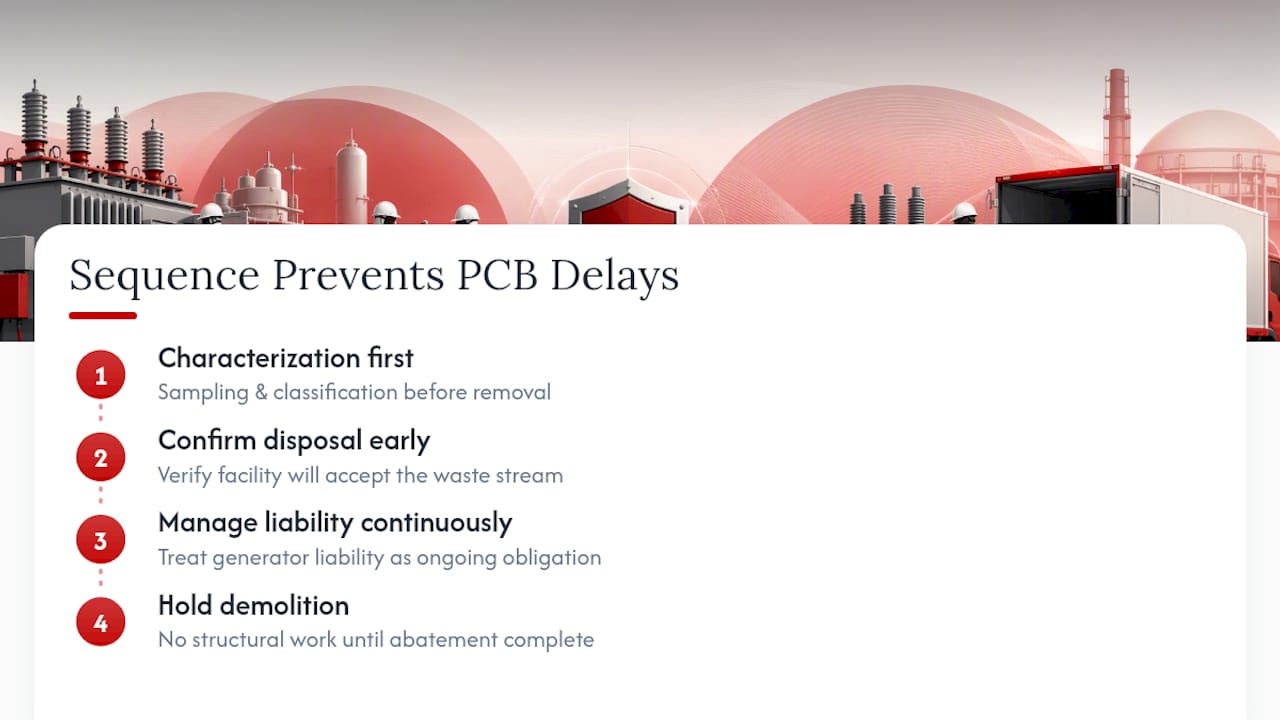
The bigger blind spot is disposal logistics. Plenty of teams nail the sampling and PPE protocols, then discover at the gate that their chosen facility won’t accept the waste stream as classified. That’s not a small hiccup, it’s a stalled project with material sitting in staging while someone scrambles for a new destination.
Prioritize disposal confirmation as early as characterization, not after. Treat generator liability as a permanent obligation, not a project-phase concern. And resist the instinct to let demolition crews start structural work while abatement is still “in progress” somewhere else on-site. Sequencing discipline is the cheapest insurance this industry has, and it’s the one most schedules quietly abandon under deadline pressure.
— Zach
Qualified Demolition Partners Reduce Your PCB Compliance Risk
A qualified demolition partner can handle both abatement and demolition phases under a single set of safety and abatement certifications, avoiding the need to coordinate handoffs between separate sampling contractors, abatement subcontractors, and demolition crews who haven’t worked together.

That integration matters most on industrial and energy-sector projects, where a missed PCB material during survey can turn a straightforward teardown into a stalled site with regulatory exposure attached. Crews equipped to manage hazardous materials as part of the demolition scope itself, rather than as an afterthought, help keep schedules realistic and disposal routes confirmed before demolition begins.
If your project involves pre-1980 structures, energy facilities, or any site where PCB-containing materials are a realistic possibility, request a site assessment from Cornelius Wrecking before you finalize your demolition timeline.
Primary Regulatory and Technical Resources
Bookmark these before your next abatement project:
- Steps to Safe PCB Abatement Activities (EPA)
- 40 CFR 761.61 — PCB remediation waste
- 40 CFR 761.62 — PCB bulk product waste disposal
- OSHA personal protective equipment guidance
- PCBs Demolition and Remodeling Manual
Sources
Planning a demolition or excavating project?
Get a fast, no-obligation quote from Cornelius Wrecking.
Request a Quote