Avoid Change Orders: Six Stage Selective Demolition for Contractors

Selective demolition is the controlled, component-specific removal of parts of a structure to preserve the rest or recover materials for reuse. Crews carry it out with hand tools, precision mechanical attachments, diamond cutting, hydraulic splitters, or hydrodemolition, depending on the material and site constraints. Use it whenever part of the structure has to stay standing, materials need to come out intact for salvage, or the site sits close enough to occupied space that a full teardown isn’t an option.
TL;DR:
- Selective demolition requires careful planning and tools such as diamond saws, hydraulic splitters, and mini-excavators to preserve materials and minimize site disruption.
- The six-stage process includes pre-demolition audits, utility disconnection, hazard abatement, and targeted structural removals, with permits mainly needed during utility and hazardous material stages.
- Safety protocols demand structural surveys, hazardous material handling, dust suppression, and exclusion zones, especially for projects in urban or occupied environments.
- Material-specific techniques like saw-cutting for concrete, mortar-joint cutting for masonry, and careful tagging of timber are essential to maximize salvage value.
- Clear distinctions between deconstruction and selective demolition influence project timelines and costs, with deconstruction typically being slower but more salvage-focused.
Table of Contents
- Where Selective Demolition Fits Among Demolition Methods
- Tools and Equipment for Precision Selective Demolition
- The Six-Stage Sequence Every Selective Demolition Project Follows
- Safety, Permits, and Hazardous-Material Compliance
- Material-Specific Techniques That Protect Value and Adjacent Work
- Selective Demolition vs. Deconstruction: Why the Label Matters
- How Cornelius Wrecking Runs a Selective Demolition Job
- Editorial Take: What the Sequencing Chart Won’t Tell You
- Get a National Contractor With the Certifications This Work Requires
- Sources
Where Selective Demolition Fits Among Demolition Methods
Total demolition drops or flattens an entire structure, usually with excavators, wrecking balls, or engineered implosion. Selective demolition works at the opposite end of the spectrum: surgical removal of specific components while everything else stays intact and structurally sound.
Between those two extremes sit several method families, each suited to a different combination of speed, precision, and site conditions:
- Soft strip demolition removes fixtures, finishes, doors, and non-structural partitions before any structural work begins, common in interior renovations and tenant buildouts.
- Mechanical selective demolition uses excavators fitted with shears, breakers, or grapples to take down targeted sections without disturbing what remains.
- Saw-cutting and diamond cutting create clean, precise openings in concrete or masonry, useful when a new door, window, or utility penetration has to go in without cracking the surrounding material.
- Hydraulic splitting wedges concrete or stone apart along a controlled line, avoiding the vibration and flying debris that come with breaking.
- Hydrodemolition uses high-pressure water jets to remove deteriorated concrete while leaving sound rebar and substrate untouched, a favorite in bridge and parking-structure rehab.
- Top-down sequencing works from the highest floor downward, which limits uncontrolled debris fall in tight urban lots but demands constant structural monitoring, according to research on controlled demolition in structures.
Dense urban sites, occupied adjacent buildings, and historic facades almost always push a project toward selective methods, because the cost of a mistake next door is higher than the cost of working slower.
Tools and Equipment for Precision Selective Demolition
The right tool depends less on brute force and more on how tightly you need to control the cut. Interior strip-out work leans on hand and power tools: reciprocating saws for framing and pipe, angle grinders for metal and tile, and pneumatic chisels for stubborn masonry or plaster.
For structural elements, compact machinery takes over. According to the Darda selective deconstruction knowledgebase, contractors favor mini-excavators, hydraulic shears, and concrete pulverizers precisely because they operate in confined or active sites where a full-size excavator would be impractical or unsafe. Diamond saws cut clean lines through concrete and masonry with minimal collateral cracking, and hydraulic wedge splitters break slabs apart along a controlled seam instead of shattering them outward.
- Hand and pneumatic tools: reciprocating saws, angle grinders, jackhammers, pneumatic chisels
- Precision attachments: diamond wall saws, wire saws, hydraulic pulverizers, wedge splitters
- Compact machinery: mini-excavators, remote-operated demolition robots for confined interiors
- Monitoring gear: crack gauges, inclinometers, dust suppression misting systems, temporary shoring
Pro Tip: Rent a compact demolition robot for any interior job with narrow doorways or low ceilings. They fit through standard door frames and cost less per day than the labor hours you’d burn breaking the same section by hand.
The Six-Stage Sequence Every Selective Demolition Project Follows
Selective demolition projects run on a documented sequence, not improvisation. The CityLoops guide for selective demolition lays out six stages that show up on nearly every well-run job:
- Pre-demolition audit and preparation. Document a material register, identify structural load points, and map utility runs before anyone picks up a tool.
- Utility disconnection. Cut power, gas, water, and data lines, and confirm each disconnect with the utility provider or a licensed electrician.
- Soft stripping. Remove loose fixtures, cabinetry, flooring, and non-structural finishes, often the fastest and cheapest stage to execute.
- Hazardous-material abatement. Sample and remove any regulated material before disturbing surfaces that might release it.
- Non-bearing and targeted structural removal. Take down partitions first, then move into bearing elements with engineered shoring in place.
- Site clearing and debris routing. Sort, stage, and haul material through pre-planned exclusion zones to keep debris paths away from active work areas.
Permit touchpoints usually cluster around stages one, two, and four. Pull permits before disconnecting utilities, and keep abatement documentation on hand for inspectors before you move past stage four.
Safety, Permits, and Hazardous-Material Compliance
OSHA’s demolition guidance requires a pre-demolition engineering survey on every job, covering the condition of the structure, adjacent construction, and the possibility of unplanned collapse. Skipping that survey is one of the more common ways contractors end up with a stop-work order.
Hazardous-materials handling follows its own sequence: sample first, abate second, disturb the structure third. Asbestos, lead paint, and PCBs each carry separate testing protocols and disposal documentation requirements, and abatement generally needs to happen before soft stripping touches the same area.
- Fall protection at every elevated work platform and open floor edge
- Fire watch during any hot-work cutting near combustible debris
- Ventilation and dust suppression, particularly during concrete cutting and pulverizing
- Clearly marked exclusion zones separating active demolition from occupied or adjacent space
Top-down sequencing reduces uncontrolled debris fall on tight urban sites, but it raises elevated-level worker risk and requires continuous structural monitoring, including engineered load-redistribution planning to avoid progressive collapse during staged removal.
Material-Specific Techniques That Protect Value and Adjacent Work
Concrete responds best to saw-cut patterns that isolate a section before pulverizers or wedge splitters take it apart, a sequence that protects rebar and keeps the remaining slab intact. Industry specification language, including sample wording in Section 024119 on selective structure demolition, consistently calls for cutting methods that avoid damaging construction meant to remain, rather than hammering or chopping through it.
Masonry rewards a slower hand. Clean saw cuts along mortar joints let a crew pull brick units for salvage instead of shattering them, and documented selective demolition procedures specifically recommend hand tools or small power saws over impact methods wherever finishes or structure need to survive.
Timber salvage lives and dies on labeling. Hand-stripping framing members one at a time, tagging each for species and dimension, is what turns a pile of lumber into resalable stock instead of firewood.
- Concrete: saw-cut isolation, then pulverize or split
- Masonry: mortar-joint saw cuts, brick-by-brick removal
- Timber: hand-strip and label immediately for reuse tracking
- MEP and finishes: controlled disconnects before removal to avoid contaminating salvage streams
Selective Demolition vs. Deconstruction: Why the Label Matters
The terms get used loosely, and that loose usage costs money on contracts. A terminology review published in Buildings found that “deconstruction” is generally defined as construction in reverse, aimed primarily at material recovery, while “selective demolition” gets applied inconsistently across the industry, sometimes meaning careful removal, sometimes meaning partial demolition with no salvage intent at all.
That ambiguity changes timelines, staffing, and price. Deconstruction is slower and more labor-intensive, but it can recover its added cost through the sale of high-quality salvaged materials, which only works if the crew removes components at salvage grade instead of speed grade.
- Define “selective demolition” and “deconstruction” explicitly in the scope of work
- Set specific salvage-quality targets by material category, not a blanket “salvage where possible” clause
- Spell out who owns recovered material and how it gets valued or credited against the contract
How Cornelius Wrecking Runs a Selective Demolition Job
Some demolition contractors hold certifications for OSHA and asbestos abatement, which matters most on the jobs where hazardous-material handling and structural sequencing overlap. That combination lets one contractor manage compliance and demolition sequencing together instead of coordinating between two separate firms.
A project-ready checklist looks like this:
- Complete the pre-demolition audit and material register before mobilizing equipment
- File utility disconnect notifications and confirm each one in writing
- Trigger abatement sampling before any soft-strip work begins in suspect areas
- Loop in a structural engineer before targeted work on bearing elements
- Stage salvage materials separately from general debris routes
Editorial Take: What the Sequencing Chart Won’t Tell You
Most guides on this topic treat the six-stage sequence as a checklist to complete, not a set of decisions to make. That’s backwards. The sequence matters less than what you decide before stage one: whether this job is really about preservation, salvage, or just doing demolition carefully. Get that decision wrong and every downstream stage inherits the mistake, usually as a change order.
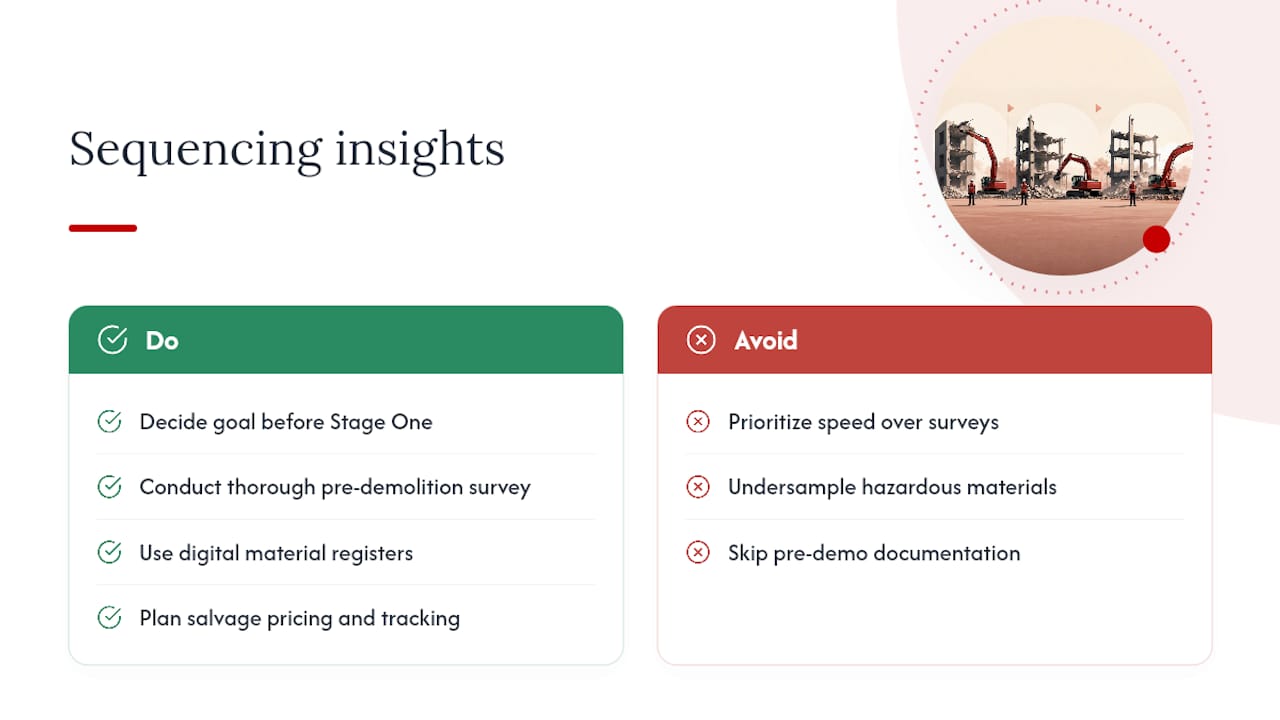
The overrated piece of conventional wisdom here is speed. Contractors chase faster cutting and faster removal when the real cost driver is almost always rework caused by skipping the pre-demolition survey or under sampling for hazardous materials. A slower stage one saves more money than a faster stage five.
What deserves more attention: digital material registers. Data-driven material passports are still an emerging practice, but they turn salvage from a vague goal into something you can actually price and track. If you’re planning a reuse-heavy project in 2026, that documentation habit will matter more than which brand of pulverizer you rent.
— Zach
Get a National Contractor With the Certifications This Work Requires
Cornelius Wrecking handles selective demolition, asbestos abatement, and site clearing under one roof, which removes the coordination gap that slows down projects split across separate abatement and demolition contractors.
That matters most on jobs where hazardous-material sampling and structural sequencing overlap, since a single certified crew can move from soft strip to abatement to targeted removal without waiting on a second contractor’s schedule. Some demolition contractors work residential, commercial, and industrial projects across regional and nationwide areas, including power plant decommissioning and marine vessel dismantling where OSHA compliance isn’t optional.
For equipment and electronics that need staged removal and disposal alongside a demolition scope, specialized destruction and logistics support can help close that gap in the plan.
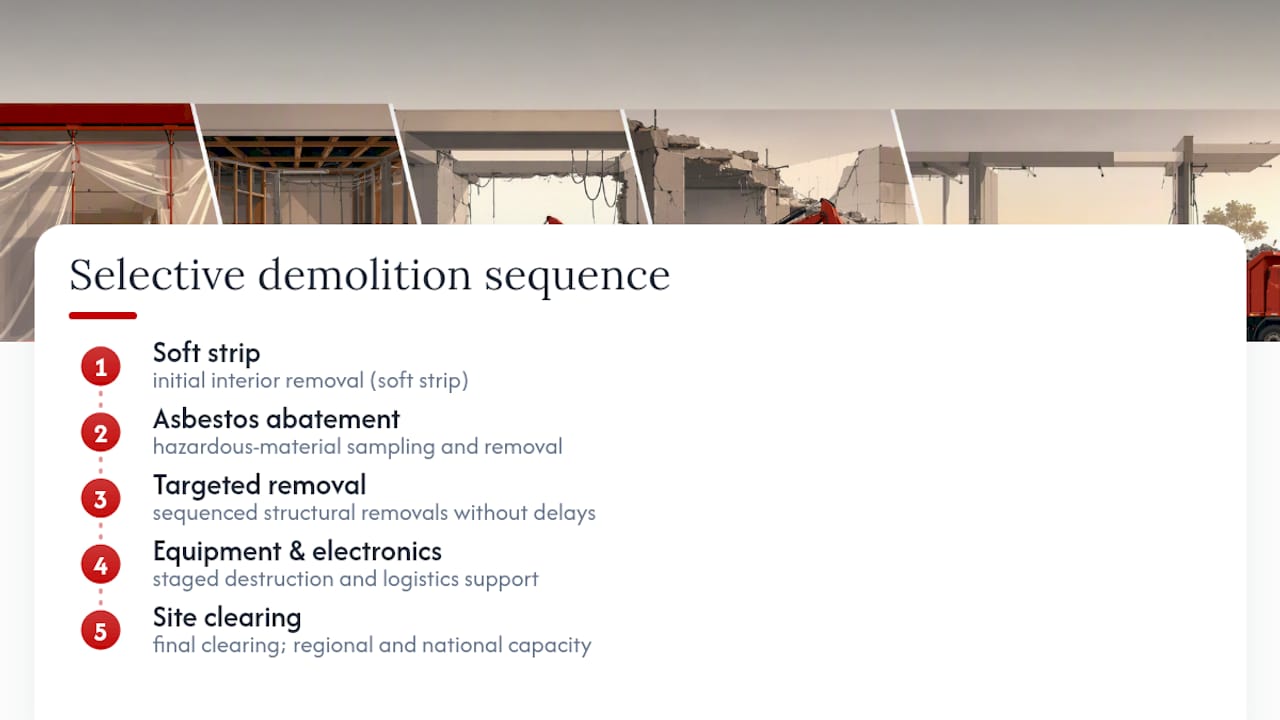
If your project needs a documented pre-demolition survey, abatement coordination, or targeted structural removal, request a project quote from Cornelius Wrecking and get a sequencing plan built around your site’s actual constraints.
Sources
Planning a demolition or excavating project?
Get a fast, no-obligation quote from Cornelius Wrecking.
Request a Quote