Site Clearing vs Grubbing: Contract Clauses Contractors Need
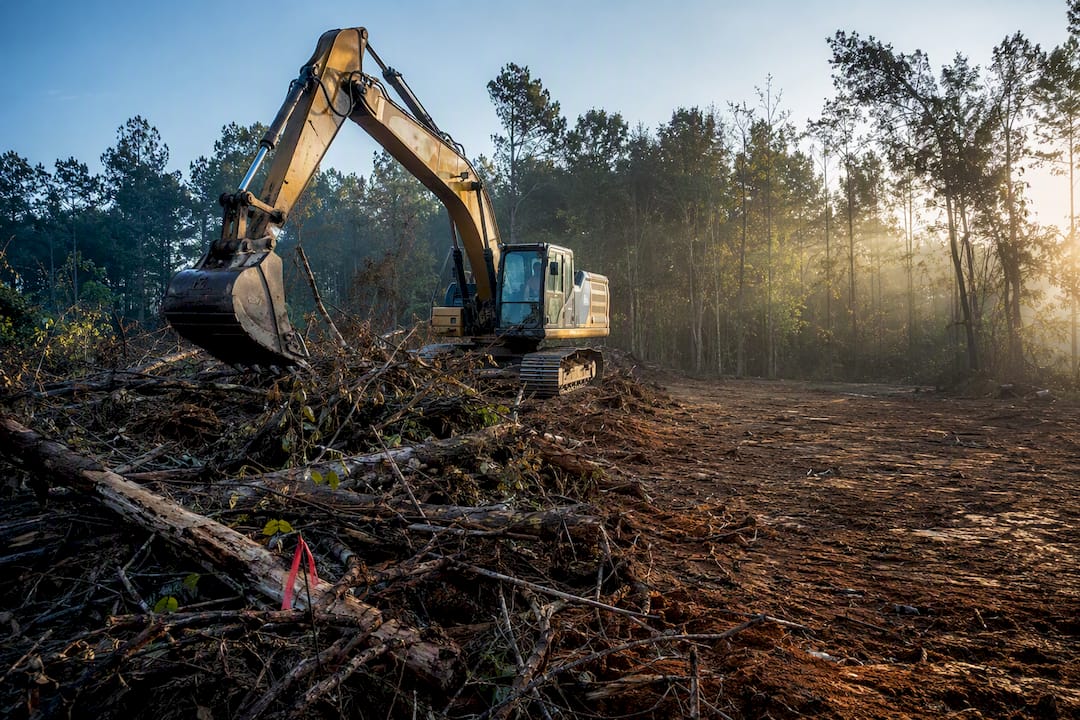
Clearing removes what you can see above ground; grubbing removes what’s still buried once clearing is done. They’re sequential, not interchangeable, and skipping grubbing on anything load-bearing invites settlement problems years later. If your project ends with pavement, a slab, or a foundation, budget and permit for both operations, not just one.
TL;DR:
- Skipping grubbing on load-bearing structures risks future settlement issues caused by decomposing roots under pavements or slabs.
- Contractors often quote grinding or full root extraction separately, so clarify which method and depth are included in the bid before accepting it.
- Permitting and erosion controls become necessary once site disturbance exposes soil, requiring early planning and documentation to avoid delays and costs.
- Costs per acre can range from $1,500 to $8,000 depending on vegetation density, access, disposal method, and required grubbing depth.
- A comprehensive scope including clearing, grubbing depth, disposal method, and permit responsibilities prevents costly change orders later on.
Table of Contents
- Site Clearing Vs Grubbing: What Clearing Actually Removes
- What Grubbing Removes Below The Surface
- When Clearing Alone Works And When You Need Grubbing Too
- Matching Equipment To The Job And What Slows It Down
- When Ground Disturbance Triggers Permits And Erosion Controls
- Cost Drivers And Per-Acre Estimating Guidance
- Why Skipping Grubbing Costs More Later
- Writing A Clearing And Grubbing Scope That Doesn’t Leave Gaps
- What Fifteen Years Of Demolition Work Teaches You About Grubbing
- Get A Site-Ready Clearing And Grubbing Quote
- Sources
Site Clearing Vs Grubbing: What Clearing Actually Removes
Clearing is the surface pass. It strips trees, brush, downed timber, and visible debris so a site is walkable and machines can move freely. Nothing goes below grade at this stage.
Contractors typically deploy a mulcher or skid steer with a brush cutter for lighter vegetation, and a dozer or excavator with a rake attachment for larger timber. On a straightforward wooded lot, clearing alone leaves a flat-looking surface, but stumps and root balls are still sitting right where the trees stood.
Pricing usually follows one of two models:
- Per-acre lump sum, common on residential and small commercial lots with fairly uniform vegetation.
- Acreage plus disposal add-on, where hauling or burning debris gets billed separately from the cutting work.
- Time-and-equipment, used on irregular parcels where density varies too much for a flat acreage rate.
A clean clearing quote should specify what happens to the cut material: mulched on-site, hauled off, or burned where local burn permits allow it.
What Grubbing Removes Below The Surface
Grubbing goes after what clearing leaves behind: stumps, root mats, and buried organic matter that clearing never touches. According to Wikipedia’s overview of the process, grubbing is typically performed after initial clearing specifically to prepare the ground for grading and construction, not as a substitute for it.
Depth matters here more than most planners expect. Root systems on mature hardwoods can run several feet down, and a shallow grub leaves fragments that decompose slowly under a slab.
There are two common methods, and they are not interchangeable:
- Stump grinding pulverizes the stump down to grade but leaves major roots in the ground.
- Full root extraction pulls the stump and root mass out entirely, usually with an excavator and thumb attachment.
Grinding works fine for landscaped areas or open lawns. Under pavement or a footing, it usually doesn’t, since decaying root systems left in place can cause future settlement or pavement failure. After proper grubbing, the site should show exposed, disturbed soil rather than a clean-looking surface. That’s a sign the work happened, not a defect.
Pro Tip: Ask the bidder directly whether their price includes full extraction or grinding only. Contractors sometimes quote grinding by default because it’s faster and cheaper, and the distinction rarely shows up unless you ask.
When Clearing Alone Works And When You Need Grubbing Too
End use should drive scope, not the other way around. Matching the operation to the outcome avoids paying for extraction you don’t need, or worse, skipping it where you do.
- Temporary access roads or staging areas. Clearing alone is often sufficient since nothing permanent sits on top.
- Paved parking or driveways. Grubbing is required. Stump fragments under asphalt create dips as they decompose.
- Foundations and slabs. Full grubbing plus topsoil stripping, typically 4 to 8 inches deep when soil is stockpiled for reuse, is standard.
- Septic fields. Grubbing is mandatory; root intrusion into leach lines is a common failure point on sites where it was skipped.
If the end use involves anything structural, assume grubbing and topsoil removal are part of the job before you ever request a bid.
Matching Equipment To The Job And What Slows It Down
The right machine for clearing is rarely the right machine for grubbing, and mixing them up wastes both time and fuel.
- Mulchers handle brush and small-diameter trees fast, working through several acres a day on flat, accessible ground.
- Dozers push cleared material into piles and grade afterward.
- Excavators with thumb attachments pull stumps and root balls for full extraction.
- Stump grinders are faster than extraction but leave roots in place, which limits where they’re appropriate.
Access is the biggest swing factor in daily output. A flat, open lot lets a mulcher clear several acres per day; steep slopes, dense timber, or a narrow easement can cut that rate substantially. Rock and ledge slow excavator-based grubbing considerably, sometimes requiring hoe-ram attachments. Wetland boundaries usually require buffer zones and specialized low-ground-pressure equipment, which adds cost regardless of vegetation density.
When Ground Disturbance Triggers Permits And Erosion Controls
Clearing alone often moves forward with minimal oversight in many jurisdictions, since cutting vegetation doesn’t necessarily expose soil. Grubbing almost always changes that. Once you’re digging and scraping, exposed soil typically pushes the project into formal land-disturbance permitting, and depending on the jurisdiction and disturbed acreage, that can mean a Stormwater Pollution Prevention Plan (SWPPP) before work continues.
Common controls required once that threshold is crossed:
- Silt fencing along the disturbance perimeter
- Stabilized construction entrances to limit tracked sediment
- Temporary sediment basins on larger sites
- Inlet protection on nearby storm drains
Sequencing matters as much as installing the controls. Erosion measures need to go in before grubbing starts, not after inspectors flag a violation. Build permit lead time into your schedule, and put in writing exactly who, contractor or owner, is responsible for filing and maintaining the SWPPP. California’s Department of Transportation construction manual treats clearing and grubbing as distinct pay items precisely because they carry different measurement and disturbance implications.
Cost Drivers And Per-Acre Estimating Guidance
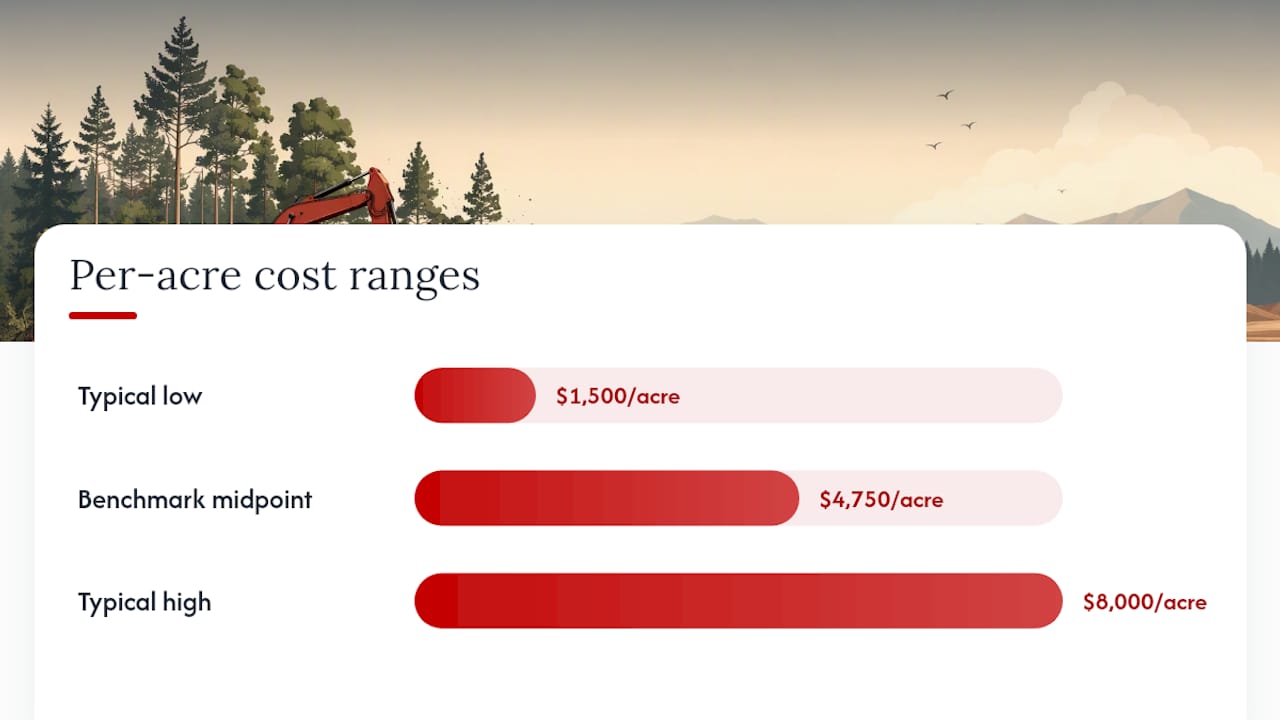
Per-acre pricing swings widely based on vegetation density, access, disposal method, and required grubbing depth. Benchmark data puts basic clearing and grubbing at roughly $1,500 to $8,000 per acre, with complex or heavily wooded sites running well above that range.
Disposal method alone can shift the total meaningfully. On-site chipping or mulching costs far less than hauling debris to a landfill, and contractors should always be asked which method their quote assumes.
| Cost Component | What Drives It |
|---|---|
| Labor and equipment | Crew size, machine hours, terrain difficulty |
| Disposal | Haul-off vs on-site chipping or burning |
| Permits and SWPPP | Jurisdiction, disturbed acreage |
| Contingency | Buried debris, rock, unexpected wetlands |
When reading a bid, ask what depth of grubbing is included, whether topsoil stripping is separate, and who absorbs the cost if buried debris or rock shows up mid-job. Vague answers on any of those three usually mean a change order later.
Why Skipping Grubbing Costs More Later
Buried stumps and root mats don’t stay buried, functionally speaking. As organic material decomposes under a slab or pavement, it leaves voids that cause settlement, cracking, and drainage problems that surface months or years after substantial completion.
Two tests catch this before it becomes a warranty claim:
- Proof-rolling with a loaded truck or roller identifies soft spots that shift under load.
- Compaction testing, often referenced against CBR or Proctor density values, confirms the subgrade meets the density the geotechnical engineer specified.
Stripped topsoil is worth stockpiling separately rather than hauling off, since it’s usually reusable for final grading and landscaping once construction wraps. Coordinate acceptance criteria with the geotechnical engineer before grubbing starts, not after, so excavation depth and compaction targets actually match the lab results.
Writing A Clearing And Grubbing Scope That Doesn’t Leave Gaps
A contract that doesn’t specify grubbing depth, disposal method, and permit responsibility is an invitation for a change order. Put these terms in writing before work starts, not after a dispute.
- State the grubbing depth in inches or feet, not “as needed.”
- Specify disposal method: on-site mulching, hauling, or burn permit.
- Name who files and maintains the SWPPP.
- Define clearing limits with a marked boundary or coordinates, not a verbal description.
- Require proof-rolling or compaction testing as a condition of acceptance where structures follow.
Before awarding, ask each bidder these questions: What depth of grubbing is included? Is disposal hauled or on-site? Who pulls the land-disturbance permit? Is topsoil stripped and stockpiled separately? What happens if buried debris is found? A bid that dodges more than one of these is worth a second look.
Pro Tip: Many contractors bundle clearing and grubbing into a single mobilization but price the two separately on the invoice. Ask for those line items broken out; it’s the fastest way to catch a quote that quietly skipped extraction.
What Fifteen Years Of Demolition Work Teaches You About Grubbing
Every settlement crack Zach has traced back to its cause eventually leads to the same finding: something organic was left in the ground that should have come out. Cornelius Wrecking carries OSHA and asbestos abatement certifications, which matters less for a wooded lot and more on industrial and energy sites where clearing runs into buried tanks, contaminated soil, or legacy structures nobody flagged in the site survey.
The lesson that saves the most money isn’t equipment choice. It’s sequencing: coordinating grubbing limits with the geotechnical engineer before excavation starts, and filing permits early enough that a two-week lead time doesn’t stall a mobilized crew.
— Zach
Get A Site-Ready Clearing And Grubbing Quote
Most site-prep contractors handle clearing fine and treat grubbing as an afterthought, which is exactly where projects run into settlement problems later. Cornelius Wrecking scopes both operations together from the start, backed by OSHA and asbestos abatement certifications that matter the moment a site turns out to have buried tanks, legacy debris, or contaminated soil nobody flagged in advance.

When you request a bid, send a site plan, access notes for equipment, and your desired clearing limits marked clearly on the drawing. That’s enough for an accurate estimate covering clearing, grubbing depth, disposal method, and permit support in one scope, rather than piecing it together after a change order shows up. Cornelius Wrecking serves Missouri, Kansas, and select nationwide projects for large-scale demolition, excavation, and site-prep work. Request a site estimate and get a scope that accounts for what’s still in the ground, not just what’s standing on it.
Sources
For spec-ready language, Caltrans’ construction manual and MoDOT’s Engineering Policy Guide both define measurement and payment terms for clearing and grubbing as separate pay items. For cost sanity-checks, compare any bid against current per-acre benchmark ranges before signing.
Planning a demolition or excavating project?
Get a fast, no-obligation quote from Cornelius Wrecking.
Request a Quote